How Thursday Evenings Reshape Downtown Snohomish From May Through October
August 6, 2026
August 6, 2026
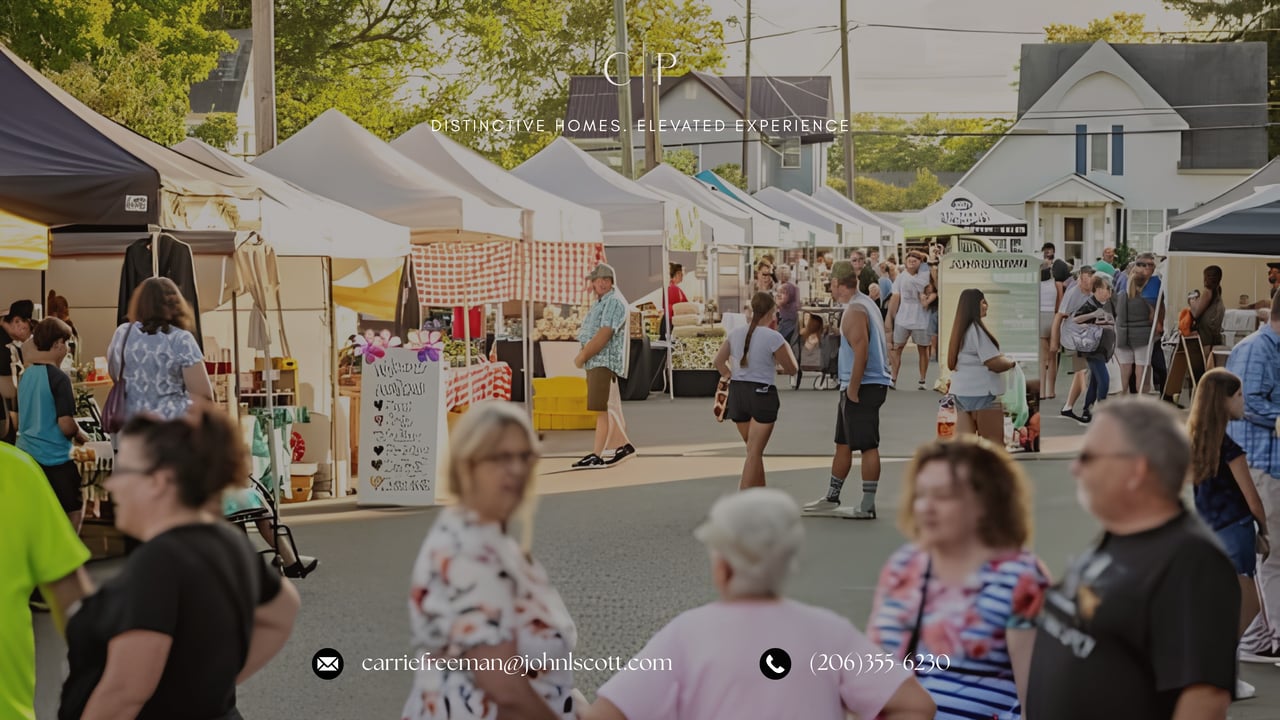
Somewhere around 2:45 on a Thursday afternoon in July, if you're walking a dog along the river or crossing Avenue A near the gazebo, you'll notice the shift. A row of white tents is already up along Cedar. A pickup with a farm decal is backing into a slot near Pearl. Someone is testing a microphone on the lawn beside the small red building at 802 First Street. By 3 p.m., six blocks of the historic district have quietly changed jobs.
For most of the year, this is a Thursday like any other. From May 7 through October 29, it is not. The Snohomish Farmers Market has grown into the largest WSFMA member market in Snohomish County, averaging around 125 vendors each week at the corner of Cedar Avenue and Pearl Street, and the businesses that ring it have started scheduling their own week around its 7 p.m. close. If you already live here, the practical question isn't whether to go. It's how to read the six hours the market touches, because Thursday now functions as a second weekend day compressed into a single afternoon.
"One of our missions is to be one of those 'third places,'" market executive director Sarah Dylan Jensen told the Snohomish County Tribune this spring.
The footprint is bigger than most residents realize until they park. The market takes up about six city blocks at Cedar and Pearl, and after last year's successful extension into October, the city approved the same expanded layout for 2026. That expansion is why parking on First feels tighter after 2:30 and why the shortcut across Avenue B disappears entirely by 3.
The market runs a rhythm rather than a schedule. If you go every week, you already know this. If you go once a month, it helps to name it:
The last stretch matters more than it sounds. It is the reason nearby restaurants and shops have started scheduling live music and evening events immediately after the market closes.
The market operates 3 to 7 p.m. from May through September and 3 to 6 p.m. in October. That one-hour compression sounds small on paper. On the ground, it reorganizes the whole Thursday.
By mid-October, the after-work surge and the eat-and-linger window collapse into each other. The crowd that used to arrive at 5:30 now arrives at 4:45 because they know the market closes an hour earlier, which means First Street's post-market handoff shifts forward too. It's the one month of the year where the market feels less like a summer festival and more like a working weekly grocery run for people who live within a mile. It is also the last real chance to shop the field, because after October 29 the season doesn't resume until the one-day Harvested Holiday Market on November 22, which returns to a handmade-homegrown-or-processed-by-the-applicant standard rather than the full vendor mix.
If you have been meaning to actually try SNAP Market Match, WIC, or the Senior Farmers Market Nutrition Program, October is the quieter month to ask questions at the coordinator tent without feeling like you're holding up a line.
This is the part most residents pick up by accident. You walk over for tomatoes, you end up at dinner. It works because the market has been running out of this corner since 1991, long enough for the surrounding block to build habits around it.
A short list of Thursday-evening anchors, all within a few minutes on foot:
The reason this matters isn't the list. It's that these shops keep their Thursday hours longer than a normal weekday in a small downtown would justify, because Jensen's team has effectively delivered them a weekly evening audience. The Historic Downtown Snohomish Association's 2026 annual report credited the district with more than 100,000 additional visits year-over-year in 2025, and Thursdays are a meaningful share of that curve. Downtown's most successful single event last year, Kla Ha Ya Days, pulled in more than $150,000 for local businesses across a single weekend. Twenty-six Thursdays quietly do a version of the same work.
If you already have kids in tow, the walk from Cedar and Pearl down to the Snohomish Riverfront Trail and Cady Park adds fifteen minutes to a Thursday that most people don't take. The lawn behind 802 First fills quickly once Music at the Market starts. The gazebo end of Avenue A is usually empty at the same hour, which is where the ice cream from the market travels better than the kettle corn does.
The First Street Master Plan is working its way through the Community Advisory Committee on the third Wednesday of each month, and one of the recurring themes in the public comment record is how to protect Thursday-evening pedestrian flow without pushing parking further out. That planning conversation is worth watching if Thursday is already part of your week. Draft concepts are being shared publicly for feedback, so what the market corridor looks like in 2028 is being decided in rooms residents are invited into now.
The generic version of a farmers market post is a list of what's in season and where to park. That's not the story here. The story is that a market founded in 1991, running one afternoon a week from a single intersection, has become large enough and long enough that a six-block section of a historic downtown has re-tuned its own hours to catch what falls off the edge of it at 7 p.m. Twenty-six Thursdays a year, downtown Snohomish behaves like it has a second Saturday.
That is worth knowing because it changes the practical answer to a very ordinary question. If you're deciding when to meet a friend downtown this month, the answer is not Saturday at noon. It's Thursday at 5:15, and you can be inside a restaurant on First Street by 7:10 without waiting for a table, having done a full week of shopping on the walk over.
If your Thursdays have been passing you by all summer, there are still ten weeks of the outdoor season left after this one, and the October rhythm is arguably the most useful one to learn. When you're ready to talk about the neighborhood beyond the market itself, Carrie Freeman Pearson and the team are here for that longer conversation. Schedule a Strategy Call whenever the timing suits you.

Real Estate Insights

Home Buying


Real Estate Insights

Real estate is built on trust and it is more than buying and selling homes, it's about having an experienced professional in your corner who can anticipate challenges, solve problems, and guide you with confidence. With over 23 years of experience, extensive market knowledge, expert negotiation skills and a genuine commitment to her clients, Carrie is known for working tirelessly to make the process as smooth and successful as possible. Whether you're buying, selling, investing, or simply exploring your options in Snohomish County, King County or the Greater Seattle Area, Carrie is dedicated to protecting your interests, providing honest advice, and delivering results every step of the way.
Carrie Freeman Pearson
108 UNION AVE SNOHOMISH, WA 98290